
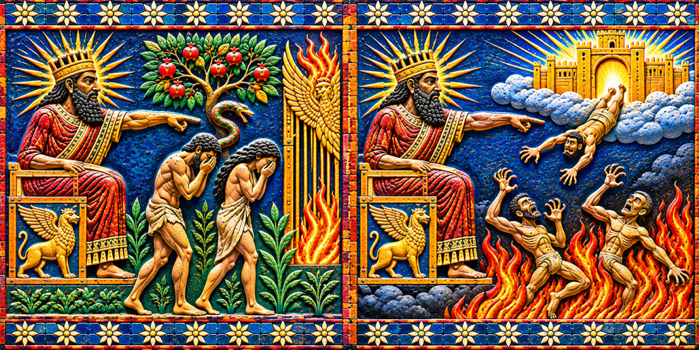
The fickle finger of Yahweh’s Paradise.
Some time ago I was talking to my uncle about religion. As he is a White Christian Nationalist of course he has almost no clue about what is actually in the bible or the culture that spawned it. As I was attempting to explain the tenuous archaeological support for the bible’s narratives he said to me, “if I’m wrong, think of the consequences”. Implying that if I died being a skeptic of Yahweh I would burn in hell. The old Pascal’s Wager Argument.
Let’s unpack that, shall we?
One would first have to ask what guarantees there would be that if you did get to heaven it would be a great place?
Exhibit A: The Garden of Eden.
So according to scripture people started out in a heavenly situation in the Garden of Eden. No death, no pain only a beautiful garden with abundant food.
There was no shame or embarrassment and Yahweh provided companionship to Adam in the form of Eve and they had direct access to Yahweh
Pretty sweet, huh? But wait!
In this paradise there was a Tree of Knowledge of Good and Evil. They were forbidden to eat the fruit from this tree. As anyone who has encountered almost any living being would understand as soon as you forbid someone from doing something, it’s going to happen. Yet Yahweh, in his infinite wisdom, who created the heavens and the earth did not understand the most basic nature of the creatures he created whatsoever. But hey, he’s a loving god, right? Surely one tiny slip up wouldn’t cause all of humanity to suffer for their little transgression.
Nope!
Yahweh imposes suffering, painful childbirth, and mortality on them and expels them setting up an angelic bouncer with a flaming sword to prevent their return.
Jeez! This bitch has got a temper.
So, we already had paradise but a slip-up was all that was needed to cast us out into a world we’ve all been living in since.
Not only do we have the Eden story, but here’s a list of fun things Yahweh did to his enemies.
1. Yahweh’s treatment of outsiders and enemies
| Event | What the biblical narrative attributes to Yahweh | Scriptural source |
| The Great Flood | Destroys nearly all humanity, including children, along with land animals, because of human wickedness. Noah’s family survives. | Genesis 6:5–7; 7:21–23 |
| Sodom and Gomorrah | Destroys entire cities with fire and sulfur, without describing a separate exemption for children. | Genesis 18:20–33; 19:24–25 |
| Death of Egypt’s firstborn | Personally strikes down the firstborn throughout Egypt, including those of prisoners and livestock, to punish Pharaoh and Egypt. | Exodus 11:4–6; 12:29–30 |
| Destruction of Pharaoh’s army | Drowns the pursuing Egyptian forces in the sea after hardening Pharaoh’s heart. | Exodus 14:4, 17–28 |
| Genocide commanded against Canaanites | Orders the Israelites to destroy the inhabitants of designated nations, sparing nothing that breathes. | Deuteronomy 7:1–5; 20:16–18 |
| Destruction of Jericho | Under Yahweh’s command, the Israelites kill men, women, young and old, and animals, sparing Rahab and her household. | Joshua 6:2–5, 20–21 |
| Extermination of the Amalekites | Commands Saul to kill men, women, children, infants, and livestock. Saul is subsequently condemned for incomplete obedience. | 1 Samuel 15:2–3, 9–23 |
| War against Midian | After a campaign described as commanded by Yahweh, Moses orders the killing of male children and nonvirgin women; virgin girls are kept alive. The distinction between Yahweh’s command and Moses’ subsequent instructions matters here. | Numbers 25:16–18; 31:1–18 |
| The ten plagues | Inflicts devastation on Egypt, including disease, destruction of crops and livestock, and the killing of firstborn children. | Exodus 7–12 |
But wait, you say! These were the enemies of his chosen people. Surely he was a benevolent and merciful god to his own?
And you would be wrong.
2. Yahweh’s treatment of his own chosen people
| Event | What the biblical narrative attributes to Yahweh | Scriptural source |
| The golden calf massacre | After Israel worships the golden calf, Moses orders the Levites, invoking Yahweh, to kill approximately 3,000 people. Yahweh also sends a plague. | Exodus 32:25–35 |
| Fire consumes worshippers | Aaron’s sons Nadab and Abihu offer unauthorized incense. Fire from Yahweh kills them. | Leviticus 10:1–3 |
| Complaining about hardship | Yahweh becomes angry at the Israelites’ complaints and burns people at the edge of their camp. | Numbers 11:1–3 |
| Complaining about food | After the Israelites demand meat, Yahweh supplies quail but strikes them with a severe plague. | Numbers 11:18–20, 31–34 |
| Refusal to enter Canaan | Condemns the wilderness generation to die before reaching the promised land. | Numbers 14:20–35 |
| Korah’s rebellion | The earth swallows rebels and their households, fire kills 250 men, and a subsequent plague kills 14,700 Israelites. | Numbers 16:23–35, 41–49 |
| The bronze serpent punishment | Yahweh sends venomous serpents among Israelites after they complain about their circumstances. Many die. | Numbers 21:4–9 |
| 24,000 die in a plague | Yahweh’s anger over Israelite involvement with Moabite women and Baal worship results in a plague killing 24,000. | Numbers 25:1–9 |
| Uzzah touches the Ark | Uzzah reaches out to steady the Ark of the Covenant when the oxen stumble. Yahweh strikes him dead. | 2 Samuel 6:6–7 |
| David’s census | Yahweh incites David to conduct a census, then punishes Israel with a plague killing 70,000 people. | 2 Samuel 24:1–15 |
| David’s infant son dies | Yahweh strikes David and Bathsheba’s infant with illness because of David’s actions. The child dies seven days later. | 2 Samuel 12:13–18 |
| Elisha and the bears | After youths mock Elisha, he curses them in Yahweh’s name. Two bears maul 42 youths. The text does not say all 42 died. | 2 Kings 2:23–24 |
| Slaughter in Jerusalem | In a prophetic vision, Yahweh commands agents of judgment to kill old and young, including women and children, except those specially marked. | Ezekiel 9:4–7 |
| Threats of cannibalism | Yahweh warns that disobedience will bring siege conditions in which parents eat their children. This is a threatened consequence, not an account of Yahweh personally killing them. | Leviticus 26:27–29; Deuteronomy 28:53–57 |
And let’s not just focus on the killings. There is also a shopping list of coercion, humiliation, collective punishment, and arbitrary restrictions to friend, foe and everyone in between.
| Incident | Scriptural source | Why it belongs |
| Tower of Babel | Genesis 11:1–9 | Yahweh disrupts human cooperation and communication, scattering people who had sought to remain together. |
| Expulsion from Eden | Genesis 3:16–24 | Yahweh imposes suffering and mortality after humans acquire forbidden knowledge, then prevents access to the tree of life. |
| Lot’s wife | Genesis 19:17, 26 | Turned into a pillar of salt after looking back toward the destruction of her home. |
| Abraham ordered to sacrifice Isaac | Genesis 22:1–19 | Yahweh tests Abraham’s obedience by ordering him to kill his son, although the killing is ultimately stopped. |
| Job’s suffering | Job 1–2; 38–42 | Yahweh permits an adversary to devastate a faithful man’s life, including the deaths of his children, and later responds to Job by asserting his superior power and knowledge. |
| Moses denied entry to Canaan | Numbers 20:7–12; Deuteronomy 32:48–52 | After decades of leadership, Moses is denied entry into the promised land for failing to uphold Yahweh’s holiness at Meribah. |
| Fire kills 102 soldiers | 2 Kings 1:9–12 | Fire from heaven consumes two groups of fifty soldiers and their commanders after Elijah calls it down. |
So my response to my uncle’s concern is that getting into heaven is no guarantee that things will go swell for eternity. And in fact I would say everyone should hope I’m correct and there is no Yahweh, because based on his own book he seems to be one of the great monsters of the universe thus turning Pascal’s wager on its head.